
Key takeaways
- A short hiss-and-spit right after the pump stops is the three-way solenoid dumping brew pressure - on most machines it's normal, not a fault.
- If the sneeze lasts more than 3-4 seconds or sprays grounds across your counter, suspect a stuck solenoid, weak spring, or a puck that never firmed up.
- Dose to the basket's rating (usually 14-18g for a double) and tamp level - a loose puck turns a polite hiss into a full mud-spray.
- Descale every 4-6 weeks in hard-water areas; scale is the number-one reason a three-way valve stops venting cleanly.
The first time a customer described it to me, she called it a “coffee sneeze.” Shot pulls fine, she flips the switch off, and a half-second later the group head goes psssht and flicks a few wet grounds onto the drip tray. She was convinced the machine was dying.
It wasn’t. On nine out of ten machines that land on my bench for this, the noise is the machine working exactly as designed.
But that tenth one is real, and telling the two apart takes about thirty seconds once you know what you’re listening for.
What is that hiss and spit actually doing?
When your pump is running, there’s roughly 9 bars of pressure sitting inside the portafilter and the group head. That’s about 130 psi pressing down on a compacted coffee puck.
The instant you stop the shot, that pressure has to go somewhere. If it didn’t, you’d lift the portafilter into a face full of hot slurry – which is exactly what happens on cheap machines that lack the part I’m about to describe.
That part is the three-way solenoid valve. On pump machines from Gaggia, Breville, Rancilio and most De’Longhi units, it opens the moment the pump cuts and vents the trapped brew pressure back down through the group and out to the drip tray.
The sound of that venting is the “sneeze.” The wet grounds are just the top layer of your puck getting nudged loose as the pressure equalizes.
A machine that sneezes is usually a machine that’s protecting your wrist. Silence is not always golden here.
Single-boiler machines without a three-way valve (many entry-level steam-wand units under $150) don’t sneeze at all. Instead the puck stays soaking wet and the portafilter resists when you twist it off. Neither behavior is a defect on its own – it’s a design difference.
How do I know if my portafilter sneezing is normal?
Normal has a signature. It’s short, it’s dry-ish, and it’s over before you’ve set your cup down.
Here’s the quick read I run through on every machine that comes in with this complaint.
- The hiss lasts under 2 seconds and then stops cleanly.
- Only a small amount of loose grounds appears, on top of the puck – not sprayed sideways.
- The used puck comes out as a firm, coherent disc you can knock into the bin in one piece.
- It happens right after the pump stops, not randomly mid-shot.
If all four are true, close the lid and enjoy your coffee. That’s a healthy espresso machine doing its pressure release.
Now the failure signature – this is when I start pulling panels.
Signs it’s crossed into a fault
- The hiss drags on for 3-4 seconds or longer, sometimes with a stuttering gurgle.
- Grounds spray across the counter, not just onto the tray.
- The puck comes out as loose mud or soup, never firming up.
- You hear the sneeze but see little to no pressure gauge movement during the shot.
That last one is the big tell. If you’ve also noticed weak extraction, it’s worth cross-checking against the reasons an espresso machine has no pressure, because the two faults often share a root cause.
Why is mine spitting grounds everywhere?
A polite sneeze turning into a mud-spray almost always comes down to the puck, not the valve. The valve is just revealing a problem that started upstream.
The puck never firmed up
If you’re under-dosing, the puck sits too low in the basket and the shower screen can’t compress it. When the pressure releases, there’s nothing solid to hold the grounds in place.
Dose to your basket’s rating. A standard double basket wants 14-18g depending on the model – I run 18g in a Breville Barista Express double and 16g in a Gaggia Classic. Weigh it on a $20 scale; don’t eyeball it.
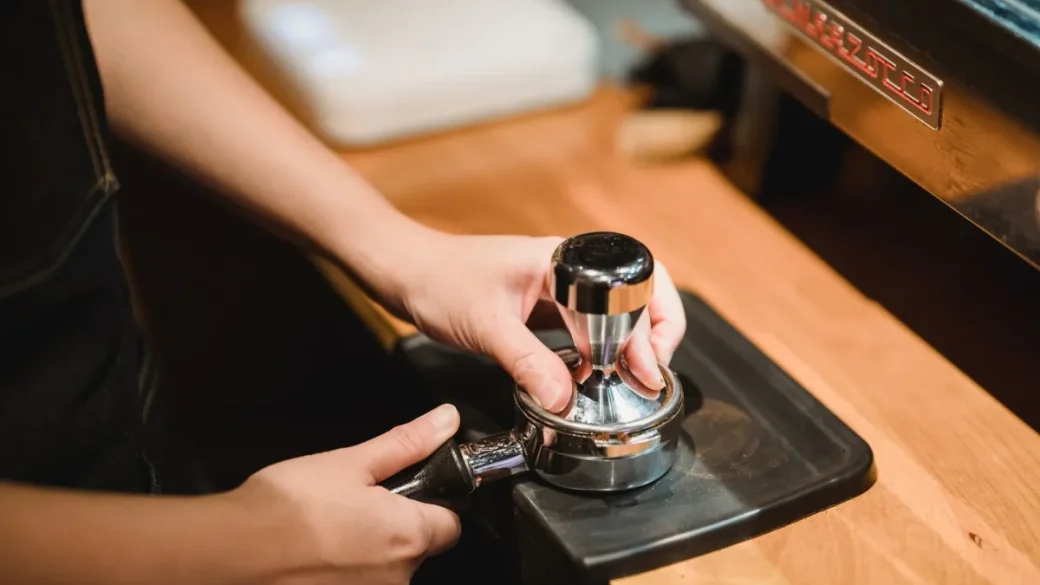
Then tamp level and firm. You don’t need 40 lbs of gorilla force, but you do need an even, flat bed. A tilted tamp leaves a weak edge that blows out first.
Do the “coin test.” After you tamp, the puck surface should look like the polished face of a coin – flat, smooth, no gaps at the basket wall. If you see a crescent gap on one side, your tamp is tilted and that side will sneeze grounds.
Grind too coarse
Coarse grounds don’t knit together under pressure. They stay loose, so the pressure release throws them around. If your shot is also gushing out in under 20 seconds and the crema is thin, the grind is the suspect – the same root cause behind espresso that pulls with no crema.
When the three-way valve itself is the problem
Sometimes the puck is textbook and it still sprays. Now I look at the valve.
The three-way solenoid is a small brass body with an electromagnetic coil, and inside sits a plunger on a spring. Over time two things go wrong: scale and wear.
Scale in the valve seat
If you’re on hard water and haven’t descaled in months, calcium builds up on the valve seat. The plunger can’t seat cleanly, so venting becomes slow and sputtery instead of a quick snap.
A descale cycle fixes early cases. I use a citric-acid solution – about 2 tablespoons of food-grade citric acid to a liter of water – run through, then two clean-water flushes. The Specialty Coffee Association and most manufacturers recommend descaling every 4-6 weeks in hard-water regions, and that schedule alone prevents most valve complaints I see.
Never open a three-way valve on a machine that’s plugged in or still hot. The boiler can hold pressure and scalding water for 30+ minutes after shutdown. Unplug it, let it cool for at least an hour, and release any residual pressure through the steam wand before you touch a wrench.
A tired plunger spring
After 4-6 years of daily use, the spring behind the plunger weakens. The valve still vents, but it’s lazy about closing, so you get that long trailing hiss.
A rebuild kit for a Gaggia or Rancilio three-way valve runs $15-30, and replacing the whole solenoid is usually $35-60 in parts. On a Breville the assembly is more integrated and often runs $70-110 through service. It’s an hour of work if you’re comfortable inside the machine.
| Symptom | Most likely cause | Typical fix | Rough cost |
|---|---|---|---|
| Short hiss, firm puck | Normal pressure release | Nothing | $0 |
| Long hiss, slow to stop | Weak plunger spring | Valve rebuild kit | $15-30 |
| Sputtering vent | Scale in valve seat | Descale cycle | $5-10 |
| Sprays grounds sideways | Loose or under-dosed puck | Dose/tamp fix | $0 |
| Puck stays soaking wet | Valve not venting at all | Replace solenoid | $35-110 |
Is a sneezing portafilter ever a leak I should worry about?
People often confuse the pressure-release sneeze with an actual water leak, and they’re different animals.
The sneeze is dry-sounding and momentary. A leak is a steady drip or a wet seam that shows up during the shot, not after it.
If water is escaping around the portafilter rim while the pump runs, that’s a worn group gasket, not a valve issue. I cover that whole family of problems in the piece on where and why an espresso machine leaks water. A group gasket is a $5 part and a 15-minute job, and it’s worth ruling out before you go chasing the solenoid.
Group gaskets harden and shrink after about 12-18 months of daily use. A quick sign yours is going: the portafilter handle creeps further and further clockwise before it locks. When it’s pointing well past center, swap the gasket.
Does the sneeze mean I pulled a bad shot?
Not by itself. The sneeze happens after extraction is finished, so it can’t affect what’s already in your cup.
What it can do is tell you about the shot you just pulled. A clean, firm puck that sneezes politely is a sign your dose, grind and tamp were dialed in. A soupy puck that sprays is the machine’s after-the-fact report card telling you one of those three was off.
So I treat the sneeze as free feedback. Read the puck it leaves behind and you’ll dial in faster.
My bench rule for this one
When someone brings me a “sneezing” machine, the first thing I do is pull a shot and watch the puck, not the valve. Eight times out of ten the puck is soft or under-dosed and the fix is technique, no tools required.
If the puck is textbook and it still sprays, then it’s descale first, spring second, full solenoid replacement last. In that order, because that’s the order of cost and effort.
And if you’re not sure whether your particular noise is the good kind or the bad kind, record ten seconds on your phone and listen back. A healthy release is a crisp single pssht. A failing valve stammers. Once you’ve heard both, you’ll never mix them up.
If the sneeze is riding alongside other gremlins – weak pours, no crema, odd noises – start with the broader overview of common espresso machine problems and their fixes and work backward from there. Most “my machine is broken” panics end at a $5 gasket or a technique tweak, and this one usually does too.
Frequently asked questions
On any machine with a three-way solenoid valve, yes. The hiss is the valve venting the roughly 9 bars of brew pressure once the pump stops, and a little loose grounds on top of the puck is expected. As long as it's a short, crisp release and the puck comes out firm, nothing is wrong.
That's almost always a puck problem, not a valve problem. Under-dosing, a coarse grind, or a tilted tamp leaves the coffee bed too loose to hold together, so the pressure release throws grounds sideways. Dose to your basket's rating, tighten the grind, and tamp level before blaming the machine.
Under two seconds is healthy. If the hiss drags on for three or four seconds, stutters, or sputters, the three-way valve is struggling - usually from scale on the valve seat or a weakened plunger spring after several years of use.
If the cause is scale in the three-way valve, yes. A citric-acid descale (about two tablespoons per liter, followed by clean-water flushes) clears early buildup and restores a clean, snappy vent. Descaling every four to six weeks in hard-water areas prevents most valve complaints from starting.
No. The sneeze is a dry, momentary hiss that happens after the shot ends. A leak is a steady drip or wet seam that shows up during the shot, and it usually points to a worn group gasket - a five-dollar part - rather than the pressure-release valve.
Not necessarily. Basic single-boiler machines without a three-way valve simply don't vent that way, so the puck stays wet and the portafilter feels stuck when you remove it. If yours used to sneeze and suddenly stopped, though, the valve may have failed and stopped venting - that's worth checking.