Key takeaways
- A drip that continues 20+ seconds after the shot ends points to the three-way solenoid valve, not your grind or tamp.
- A slow weep only during and just after brewing is usually a hardened group gasket - a $6 part and a 15-minute job.
- Descale first: scale on the valve seat causes about a third of the drips I see, and it costs nothing to rule out.
- Never chase a group head leak with the machine hot and pressurised - burn risk and scald risk are real at 200F/9 bar.
- If plain water with no basket still drips, the problem is mechanical (valve or seal), full stop.
A customer dropped off a Gaggia Classic last winter convinced it was possessed. Every 30 seconds, whether he’d pulled a shot or not, a fat drop of water would fall from the portafilter and hit the drip tray with a little metallic tink. He’d already replaced the shower screen, the basket, and the portafilter gasket. None of it mattered.
The fault was a solenoid valve seat with a fleck of scale sitting on it the size of a poppy seed.
Group head dripping is one of those symptoms that sends people down every wrong road first. It looks like a coffee problem or a seal problem, and sometimes it is – but a constant, rhythmic drip between shots is almost always a valve telling you it can’t hold pressure. Let me walk you through how I sort one from the other on the bench.
Is my group head supposed to drip at all?
A little bit, yes. A few drips right after you remove the portafilter are completely normal – that’s residual water in the shower screen and dispersion block draining out. On a machine with a three-way solenoid, you’ll also hear a short hiss and see a quick release into the tray the moment the shot ends. That’s the valve dumping pressure so your puck isn’t a soaking mess.
What isn’t normal is a drip that keeps going. If your brew head is still releasing water 30, 60, 90 seconds after everything should be still, the machine has a fault.
Normal drains and stops within about 10 seconds. A fault keeps ticking like a leaky faucet.
The quickest test I know: pull the portafilter out, wipe the group dry, and just watch it for a full minute with the machine on but idle. A healthy group stays dry. A dripping one won’t.
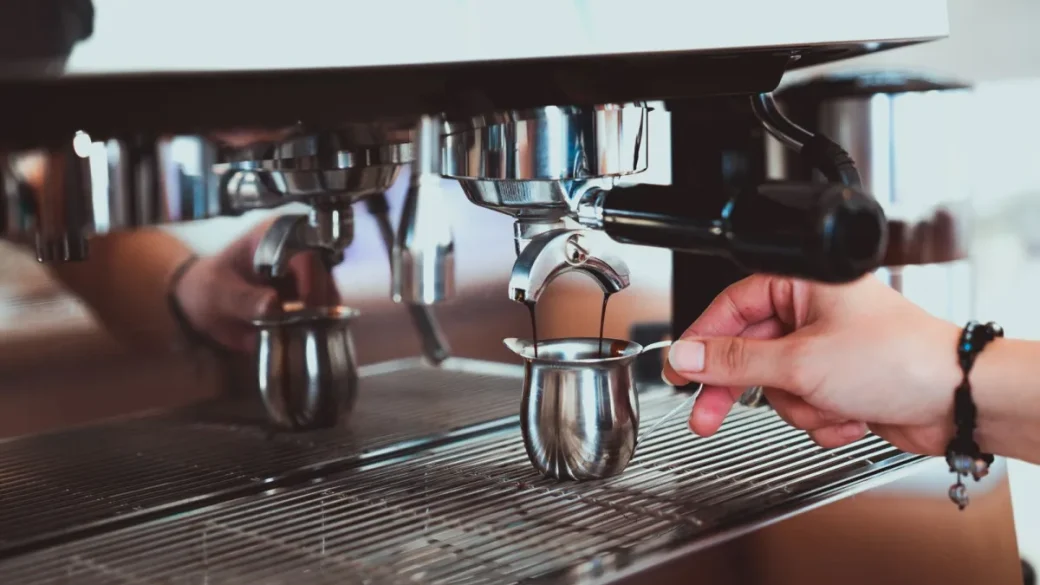
Why does my group head keep dripping between shots?
Nearly every constant drip I see traces back to one of three things. Getting the order right saves you money, because the cheapest fix is also the most common.
1. The three-way solenoid valve isn’t sealing
This is the big one on any machine that has a solenoid – most Gaggia, Rancilio, and Breville models do. The valve has one job at rest: seal the brew circuit so pressurised water in the boiler and lines can’t creep up through the group. When the rubber seat inside wears, or a chip of scale lodges on it, water seeps past continuously.
The tell is timing. Solenoid drips are relentless and evenly spaced because they’re driven by standing boiler pressure, not by anything you did. If your machine drips the same whether you brewed 5 minutes ago or an hour ago, look here first.
Not every machine has a three-way valve. Many De’Longhi and entry-level Breville units use a simpler pressure-relief design, so their brew heads drip more freely by design and stop when the lines depressurise. Check your model before you go hunting for a solenoid that isn’t there.
2. A hardened or split group gasket
The group gasket (the doughnut-shaped seal the portafilter locks against) does more than stop side leaks. When it goes hard and glassy – usually around the 12 to 18 month mark on a daily-use home machine – it stops sealing the puck cleanly and lets water track back and drip.
Gasket drips have a different signature. They tend to weep during and just after the shot, then taper off, rather than ticking away indefinitely. A $6 gasket and 15 minutes fixes it. I go into the broader picture of stray water in Espresso Machine Leaking Water: Where & Why if the drip is coming from the edge rather than the center.
3. Scale on the valve seat or in the group
Scale is the silent partner in maybe a third of the drips that come across my bench. It doesn’t need to block anything – a single hard flake on a valve seat holds the valve open a hair, and that’s all a drip needs. Hard-water areas see this constantly.
Before you order a single part, run a full descale cycle with a proper citric or lactic descaler and let it dwell 20 minutes, not the 5 the box suggests. I’ve cured genuine solenoid drips with nothing but a patient descale. It’s the only free fix on this list – always try it first.
How do I tell a valve drip from a seal drip?
You isolate the coffee out of the equation, then you time it. Here’s the exact sequence I run.
- Lock in a clean, empty portafilter – no basket, no coffee – and run 3 to 4 seconds of plain water through, then stop.
- Remove the portafilter, wipe the shower screen and group face bone dry with a cloth.
- Leave the machine switched on and idle. Do nothing.
- Watch and time the first drip. Under 10 seconds and stopping? Normal drain-off. Still dripping past 30 seconds? Mechanical fault.
- Now note where it forms – dead center from the shower screen points to the valve or dispersion path; from the outer rim points to the group gasket.
If it still drips with plain water and no puck at all, you’ve proven it’s not your coffee, your grind, or your tamp. That single test settles more arguments than anything else in my kit.
Brew water sits near 200F (93C) and the circuit can hold 9 bar. Never poke at a group head, loosen a fitting, or open a solenoid while the machine is hot and powered. Switch off, unplug, and let it cool 30 to 45 minutes so residual pressure bleeds down before you touch anything. A face full of near-boiling water is not worth saving 15 minutes.
What does it cost to fix a dripping group head?
The good news is that none of these are expensive parts. The labour is the variable, and most of it is DIY-friendly if you’re comfortable with a screwdriver and a torx set.
| Fix | Typical part cost (USD) | Time | Difficulty |
|---|---|---|---|
| Full descale (rule out scale) | $8–15 descaler | 40 min | Easy |
| New group gasket | $4–8 | 15 min | Easy |
| Solenoid valve rebuild seal kit | $10–20 | 45 min | Moderate |
| Complete three-way solenoid valve | $30–55 | 1 hr | Moderate |
When I reassemble a solenoid, I snug the fittings to roughly 10–12 Nm and no more – these are brass, and over-torquing cracks them or crushes the O-ring so it leaks worse than before. Hand-tight plus a quarter turn is a safe rule if you don’t have a torque wrench.
Solenoid valves fail more from crud than from age. If yours is dripping, the seat is almost always dirty rather than dead. A rebuild kit for a couple of dollars fixes far more valves than a full replacement – try the seal kit before buying the whole assembly.
Can I keep using the machine while it drips?
Short term, physically, yes – a slow drip won’t hurt you and the machine will still pull shots. But I’d stop sooner rather than later for two reasons.
First, a leaking valve means the boiler is quietly refilling and reheating more than it should, which wastes energy and works the pump harder. Second, constant moisture in the group promotes scale and mineral buildup exactly where you don’t want it, so a small problem grows.
There’s also a diagnostic reason. A dripping group can mask or mimic other faults – people confuse it with weak extraction or a machine that won’t build pressure. If your shots have gone flat too, it’s worth reading Espresso Machine Has No Pressure: Causes alongside this, because a failing valve can hit both. A drip that comes with pale, lifeless shots and thin crema often shares a root cause – I cover that side in Why Your Espresso Has No Crema.
The design of pump espresso machines depends on the brew circuit holding pressure cleanly between shots, so a persistent drip is genuinely worth chasing down rather than living with.
Fixing it without making it worse
If you take one thing to the bench, make it patience. The mistake I see most is people swapping the expensive solenoid first, finding it still drips, and only then discovering the real culprit was scale or a $6 gasket they never touched.
Work the cheap-to-dear order every time: descale, inspect the group gasket, then rebuild the valve seat, then – and only then – replace the whole valve. Nine out of ten dripping group heads I fix never get past step two or three.
And if you’ve done all of that and it’s still ticking away into the tray, that’s your sign the fault is deeper in the brew group or the machine has a control issue worth a proper look – my broader walkthrough at Espresso Machine Not Working? Problems & Fixes is where I’d send you next. For dialing in the shot itself once the hardware’s sound, the Specialty Coffee Association has solid brewing references worth a look.
Get the drip stopped and you’ll notice something small but satisfying: a bone-dry group and a portafilter that comes out with a clean, dry puck instead of a soupy mess. That’s the machine telling you the valve is finally doing its one job.
Frequently asked questions
A few drips over the first 5 to 10 seconds is completely normal residual drain-off, especially on machines with a three-way solenoid that releases pressure at the end of a shot. If the drip continues past 30 seconds, or ticks away steadily while the machine sits idle, you have a mechanical fault rather than normal behavior. Wipe the group dry and time it to be sure.
Not usually. Most solenoid drips come from scale or grime sitting on the valve seat, not a dead valve, so a full descale or a cheap rebuild seal kit fixes far more of them than a complete replacement. Try descaling first, then a seal kit, and only buy the whole $30 to $55 valve if those fail.
That is actually the clearest diagnostic result you can get. If it drips with plain water and no puck, the problem is definitely mechanical - a valve or a seal - and has nothing to do with your grind, dose, or tamp. It points you straight at the solenoid or the group gasket.
For a short time, yes, but I would fix it soon. A leaking valve makes the boiler refill and reheat more than it should, wastes energy, and encourages scale buildup in the group. It can also mask other faults like weak pressure, so it is worth ruling out before it grows into a bigger repair.
Yes, and it is the first thing I try because it costs almost nothing. A single flake of scale on a valve seat can hold it open just enough to drip, so a proper descale with a 20-minute dwell time clears it. Roughly a third of the drips I see are cured this way with no parts at all.
Yes. An edge or rim leak usually points to a hardened or split group gasket, the seal the portafilter locks against, which typically needs replacing every 12 to 18 months on a daily-use machine. A center drip from the shower screen points more toward the valve or dispersion path. The location tells you which part to check first.