Key takeaways
- A machine that hums but moves no water is almost always airlocked or scaled up, not a dead pump - check those before you buy parts.
- Prime the pump by running water through the steam wand with the portafilter off; this clears 8 out of 10 no-flow cases in under two minutes.
- Descale every 4-6 weeks with citric acid or De'Longhi EcoDecalk; hardened scale in the solenoid is the number one killer of these pumps.
- A genuine Ulka vibratory pump costs $18-$30 and swaps out in about 20 minutes with a Torx T20 and a couple of hose clamps.
The call I get most in summer goes like this: the machine powers up, the pump buzzes like an angry wasp, but not a single drop makes it to the cup. The owner is convinced the pump is dead. Nine times out of ten, it isn’t.
A De’Longhi that runs but moves no water is one of the most fixable faults on the bench. The buzzing you hear is the pump trying to do its job against an air pocket, a clogged path, or a wall of limescale.
I’ve stripped down dozens of Dedica, Magnifica, and Stilosa units over the years. The pattern almost never changes, so let me walk you through the exact order I check things in.
What that buzzing pump is actually telling you
Nearly every consumer De’Longhi uses a vibratory pump – usually an Ulka EP5 or EX5 rated around 15 bar. It’s the same little black pump you’ll find inside Gaggia and Breville machines too.
That pump moves water by rapid oscillation, not by spinning. It can only pull water if there’s an unbroken column of it from the tank all the way through. Introduce a single air bubble and the pump loses its grip – it buzzes hard but pumps nothing.
So when a De’Longhi espresso machine is not pumping water but the motor is clearly alive, you’re rarely looking at a failed pump. You’re looking at a broken water path.
A vibratory pump that hums but won’t prime is starved, not broken. Feed it a solid column of water and it usually wakes right up.
If the pump makes no sound at all – dead silence when you hit brew – that’s a different fault. Then you’re chasing power, a blown thermal fuse, or a cracked control board, not a water-path problem. This article is about the buzzing-but-dry machines.
Start here: reseat the tank and prime the pump
Before you unscrew anything, do the two-minute fix that solves most cases.
Pull the water tank out completely and look at the base. There’s a spring-loaded valve there that mates with a spout inside the machine. If the tank sits crooked or there’s grit on that valve, the machine draws air instead of water.
Reseat the tank firmly. You should feel it click home and meet a slight resistance from that valve.
Forcing a prime
Now clear the airlock. Take the portafilter off entirely, put a cup under the steam wand, and open the steam knob.
- Fill the tank to the max line with fresh, room-temperature water
- Turn the steam dial fully open
- Run the pump for 20-30 seconds until water flows steadily from the wand
- Close the dial, then run water through the empty group head for another 15 seconds
Opening the steam path gives the trapped air an easy exit. I’d estimate this alone fixes eight out of ten no-flow De’Longhis that walk through my door.
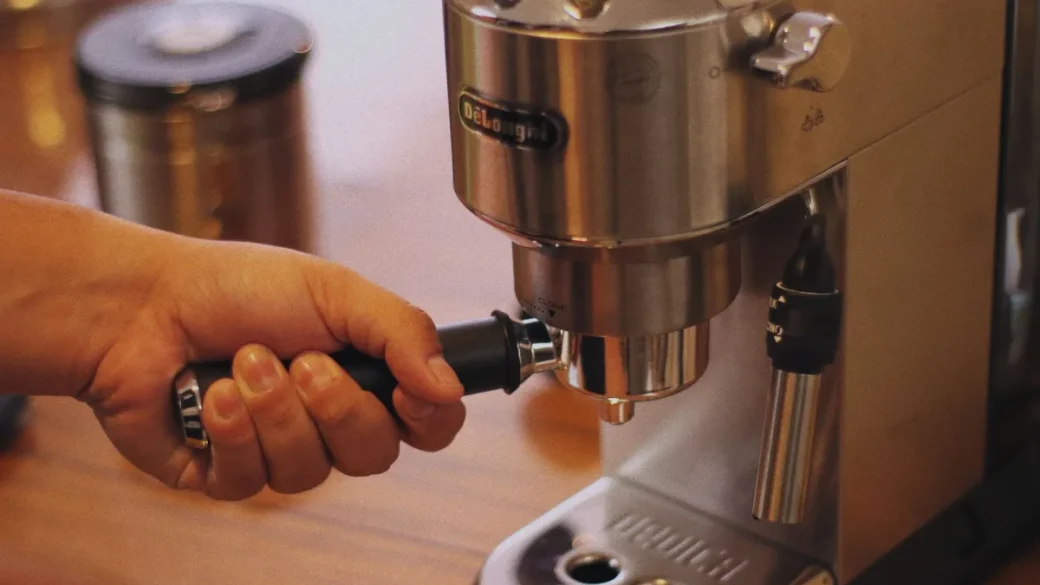
Warm the water to about body temperature before priming. Warm water holds less dissolved air and breaks an airlock faster than cold water straight from the fridge. It’s a small trick that saves real time.
The real villain: limescale in the solenoid and boiler
If priming doesn’t do it, scale is your prime suspect. This is the single most common mechanical cause I see, especially on machines run on hard tap water for a year or two without descaling.
Scale builds up inside the aluminum thermoblock and, worse, inside the small solenoid valve that directs water between brew and steam. A partially blocked solenoid lets the pump run but chokes the flow down to nothing.
The fix is a proper descale – not the half-hearted kind.
Descaling that actually works
Mix a real descaling solution. I use either De’Longhi EcoDecalk (about $12 a bottle) or plain food-grade citric acid at roughly 30 grams per liter of warm water, which costs pennies.
Run a third of it through, then stop and let it sit in the boiler for 15-20 minutes. That soak time is what dissolves hardened scale – flushing it straight through does almost nothing.
Repeat the soak-and-run cycle until the tank is empty, then rinse with two full tanks of clean water. On a badly scaled machine I’ll sometimes run the acid solution through twice before flow returns to normal.
Never use vinegar as a shortcut. It leaves a smell that lingers for weeks and its acetic acid can attack the internal seals and gaskets over time. Citric acid or a proper descaler like the ones the manufacturer sells is the only thing I’ll put through a customer’s machine. You can read De’Longhi’s own care recommendations at De’Longhi’s site.
Descaling on a schedule prevents this fault entirely. Every 4-6 weeks for hard-water areas, longer if you’re on soft water or run a filter. If your machine has also lost pressure, the same scale is often behind that, and I go deeper on it in this look at espresso machine pressure problems.
Check the intake hose and inlet screen
Still dry? Time to open the case. On most models it’s a handful of Torx T20 screws around the base and back panel.
Inside, follow the silicone hose from the tank valve to the pump inlet. Two things go wrong here.
Cracked or kinked intake hose
The hose that feeds the pump can perish and crack, especially near the clamps where it flexes. A hairline split lets the pump suck air instead of water – same buzzing symptom as an airlock, but permanent.
Squeeze along its length. If it’s brittle or you see a crack, replace it; generic food-grade silicone hose runs a few dollars and I always fit fresh stainless hose clamps while I’m in there.
Clogged inlet screen
There’s a tiny mesh screen at the pump inlet that catches debris. On older machines it gets caked with scale flakes and mineral grit, throttling flow to a trickle.
Pop it out, soak it in the same citric solution for ten minutes, and brush it clean. A clogged inlet screen mimics a failing pump almost perfectly.
When it really is the pump
Only after ruling out air, scale, and hoses do I condemn the pump itself. Ulka pumps are workhorses, but they don’t last forever – around 5-7 years of daily use is typical before the internals wear.
Here’s the bench test. Disconnect the outlet hose, put the pump inlet directly into a cup of water, and run it. If it can’t pull water even with a clean, unrestricted path right in front of it, the pump is done.
| Symptom | Likely cause | Typical fix cost |
|---|---|---|
| Buzzes, no water, cured by priming | Airlock / tank seating | Free |
| Weak trickle, gets worse over months | Scale in solenoid/boiler | $0-$12 descaler |
| Sucks air after fresh prime | Cracked intake hose | $3-$8 hose + clamps |
| No flow even on a clean test bench | Failed Ulka pump | $18-$30 pump |
A genuine replacement Ulka EP5 costs $18-$30 online. Swapping it is about 20 minutes of work: two spade connectors, two hose clamps, and one mounting bracket. Match the voltage (120V for North America) and the model number stamped on the side.
Unplug the machine and let it cool for at least 30 minutes before opening the case. The thermoblock holds heat, and there’s mains voltage on the pump terminals. If you’re not comfortable around wiring, this is the point to hand it to a technician.
The vibratory pump has been the heart of home espresso machines for decades precisely because it’s cheap and easy to replace, so don’t feel you’ve hit a dead end if it needs one.
Keeping water flowing for the long haul
Once your machine is pumping again, a few habits keep it that way. Empty the tank if you won’t use the machine for a week – standing water grows biofilm that clogs screens and breeds the next airlock.
Descale on a calendar, not when problems appear. By the time flow drops, the scale is already hardened and harder to clear.
And if the machine ever sits unused for a while, prime it through the steam wand before your first shot rather than expecting it to self-prime cold.
If you’ve worked through all of this and the machine still won’t cooperate, it’s worth stepping back to the bigger picture in this rundown of common espresso machine problems and their fixes. Related symptoms often share a root cause – a machine that’s pulling shots with no crema or leaking from somewhere it shouldn’t is frequently the same scale or seal issue showing a different face. Chase the water path, and most of these machines come back to life on your own kitchen counter.
Frequently asked questions
That buzz is the vibratory pump running against an air pocket or a blockage - it's straining but can't grip a solid column of water. Reseat the tank and prime the machine through the steam wand with the portafilter removed. This clears the airlock in most cases within a minute or two.
Fill the tank with fresh water, remove the portafilter, put a cup under the steam wand, and open the steam knob fully. Run the pump for 20-30 seconds until water flows steadily, then close the knob and run water through the empty group head. Opening the steam path gives trapped air an escape route.
Yes. Scale builds inside the solenoid valve and thermoblock and can choke flow down to nothing while the pump keeps running. Descale with citric acid or a De'Longhi descaler, letting the solution soak in the boiler for 15-20 minutes rather than flushing it straight through, which barely touches hardened scale.
A genuine Ulka vibratory pump runs $18-$30 online, and the swap takes about 20 minutes with a Torx T20 driver. Just match the voltage and the model number stamped on the pump body. Replace the pump only after ruling out airlocks, scale, and cracked hoses first.
No. Vinegar's acetic acid can degrade internal seals and gaskets, and the smell lingers for weeks. Use food-grade citric acid at about 30 grams per liter of warm water, or a proper descaler like De'Longhi EcoDecalk. Both dissolve scale effectively without harming the machine.
Every 4-6 weeks if you're on hard tap water, and less often on soft water or with a filter fitted. Descaling on a fixed schedule prevents scale from ever hardening in the solenoid, which is the number one mechanical cause of no-flow on these machines.