Key takeaways
- Rule out the basics first: a stale grind, empty tank, or unprimed pump cause most 'no pressure' calls before any part has failed.
- A vibration pump that hums but moves no water is usually air-locked or has a seized valve - prime it before you condemn it.
- A blown OPV, cracked pump, or perished group seal are the three hardware faults that kill pressure outright; each has a distinct tell.
- Test with a blind filter and a gauge portafilter - you want to see the needle, not guess at it.
- Most fixes here run $8 to $60 in parts; a new pump is the ceiling on a home machine before repair stops making sense.
A machine that pulls a limp, dribbling shot is annoying. A machine that produces nothing – portafilter locked in, pump running, and not a drop of resistance – is a different animal. That second one is what lands on my bench most Mondays.
The good news is that a total loss of brew pressure has a short list of suspects. I’ve torn down enough Gaggia Classics and Breville Barista Express units to know they fail in the same handful of ways, roughly in the same order of likelihood.
So let’s work the chain from the water tank to the group head, the way I’d do it if your machine were sitting in front of me.
First, prove it’s actually the machine and not the coffee
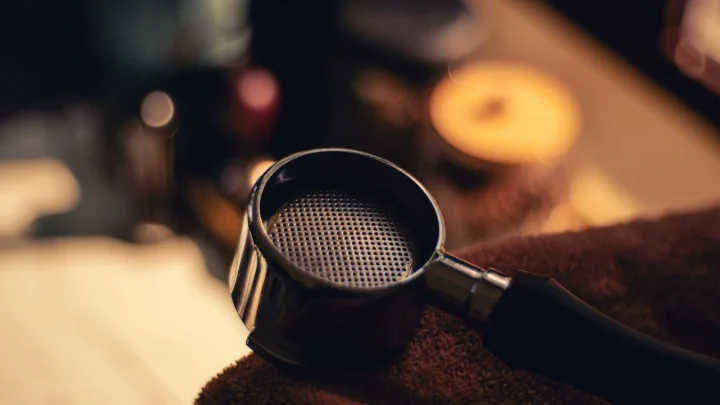
Before I open anything, I run a blind test. Pop the basket out of the portafilter, drop in a blind (unperforated) filter disc, lock it in with nothing else, and hit the brew switch.
If the pump strains against the blind filter and the pressure gauge climbs to 9 bar or so, congratulations – your machine is fine and the problem is upstream in your prep. A grind that’s too coarse, a dose that’s too light, or a puck with a channel blown through it will all read as “no pressure” at the cup while the machine works perfectly.
I can’t tell you how many “broken” machines I’ve handed back after showing the owner their $12 blade grinder was the culprit. If the shot gushes with zero resistance, that’s almost never a pump fault – it’s grind or dose. The reasons espresso comes out with no crema overlap heavily with this, so it’s worth ruling out first.
A blind filter disc costs about $6 and doubles as your backflush tool. If you own an espresso machine and don’t have one, buy one before you buy anything else – it turns “no pressure” from a guessing game into a two-minute test.
The tank, the valve, and the priming problem
Now assume the blind test failed too – the pump runs but the gauge stays flat. Time to move upstream.
Water actually reaching the pump
Vibration pumps, the little Ulka or CEME units in most home machines, cannot pull water from a dry state well. If the tank ran empty even once, air gets into the line and the pump will happily buzz away moving nothing but air.
Fill the tank, pull the portafilter off entirely, and run water through the open group head for 20 to 30 seconds. You’re trying to purge the air lock. Nine times out of ten a machine that “died” right after running dry just needs to be re-primed this way.
The one-way valve on the tank
Most reservoirs seat onto a spring-loaded check valve. If that little valve sticks shut – mineral scale is the usual reason – water never reaches the pump no matter how full the tank is. Press it with a toothpick; it should click and spring back freely.
A vibration pump makes a loud, rhythmic buzz under load and a smoother, higher-pitched whine when it’s just moving air. Learn the difference by ear and you can diagnose an air lock without taking a single screw out.
The pump itself: humming, dead, or worn out
If water is reaching the pump and it’s still producing nothing, the pump is now a real suspect. A vibration pump can fail three ways.
- Dead silent – no hum at all usually means an electrical fault (blown thermal fuse, broken wire, failed switch), not the pump body itself.
- Humming but no output – the internal piston or valve has seized, often from scale. Sometimes descaling frees it; often it doesn’t.
- Weak and inconsistent – worn internals. It’ll build 4 or 5 bar and stall instead of the 9 you need.
A genuine Ulka EP5 or EX5 replacement runs $25 to $45 and swaps in with two spade connectors and a hose clamp or two. On the bench I budget about 30 minutes for the job, most of it spent fighting the silicone hoses. This is a real machine, not an appliance, so more on how espresso extraction actually works lives in the general espresso machine literature if you want the theory.
Unplug the machine and let the boiler cool completely before you open the case. These units hold mains voltage across the pump and thermostat, and the boiler can sit at 250°F/120°C long after the pump goes quiet. Never work on a plugged-in espresso machine.
The OPV: the part everyone forgets
Here’s the fault I see constantly that owners never suspect. The over-pressure valve – the OPV – is a spring-loaded relief valve set to bleed off anything above roughly 9 to 12 bar back to the tank.
When the spring weakens or the valve seat gets fouled with scale, it stops sealing. Instead of the pump’s output going to the group head, it dumps straight back into the reservoir. The pump runs, water circulates, and the puck sees almost nothing.
The tell is subtle: you’ll often hear water trickling back into the tank while you brew, and the shot comes out fast and weak rather than not at all. On a Gaggia Classic the OPV is a brass fitting you can access from the top; adjusting or cleaning it is a 15-minute job, and a replacement valve is about $15 to $30.
If the pump runs and you can hear water returning to the tank during a brew, suspect the OPV before you suspect the pump.
Seals, gaskets, and the leak that steals your pressure
Pressure that’s generated but leaks out before it reaches the puck is the last big category. This is where “no pressure” and “leaking water” become the same fault seen from two angles.
The group head gasket
The portafilter seals against a rubber group gasket. When that gasket hardens with age – typically every 12 to 18 months of daily use – the portafilter no longer seats tightly, and pressurized water escapes around the rim instead of forcing through the coffee. You’ll see water spraying out the sides of the portafilter mid-shot.
A new group gasket is a $5 to $10 part. Getting the old one out is the annoying bit; I use a small screwdriver and a corkscrew, and it takes about ten minutes of patient prying.
Internal seals and the solenoid
Deeper in, a perished pump-outlet seal or a stuck three-way solenoid valve can bleed pressure inside the case where you never see it. If your machine is also dripping from underneath, cross-reference the symptoms with where an espresso machine leaks water and why – an internal leak and a pressure loss frequently share one failed O-ring.
| Symptom | Most likely cause | Typical fix cost |
|---|---|---|
| Pump hums, no water at all | Air lock or seized pump | $0 (prime) to $40 (pump) |
| Water trickles back to tank, weak shot | Faulty OPV | $15–$30 |
| Water sprays around portafilter rim | Hardened group gasket | $5–$10 |
| Full tank, dry group head | Stuck tank check valve | $0–$12 |
| No hum, no lights | Thermal fuse / wiring | $8–$20 |
Where I’d stop and call it
Work that chain in order – coffee, tank, pump, OPV, seals – and you’ll corner the fault without shotgunning parts you don’t need. Most of these repairs land between $8 and $60, which is why keeping a decent home machine alive almost always beats replacing it.
The exception is a machine where the pump and the boiler have failed, or where scale has fused half the internals. On a sub-$200 unit, once you’re past $80 in parts and a full afternoon, a rebuild stops making sense. Descaling every 2 to 3 months with a proper solution – the Specialty Coffee Association publishes solid water-quality standards worth following – prevents most of what I’ve described here.
If your machine is throwing more than one symptom at once, or you’re not sure where in the chain you are, start with the broader espresso machine problems and fixes overview. And if the pump runs but nothing heats, that’s a separate branch entirely – check what to do when the espresso machine won’t heat up before you condemn the pump.
Frequently asked questions
That loud buzz with no output is the classic sign of an air-locked vibration pump, usually because the tank ran dry at some point. Fill the tank, remove the portafilter, and run the open group head for 20 to 30 seconds to purge the air. If it still won't draw water after priming, check the tank's one-way check valve for scale before suspecting the pump itself.
Run a blind filter test: lock a blind (unperforated) disc into the portafilter and brew. If the gauge climbs to around 9 bar, the pump is fine and your grind or dose is the real problem. If the pump runs but pressure stays flat against a blind filter, the fault is the pump, the OPV, or an internal seal.
The over-pressure valve is a spring-loaded relief valve that dumps anything above roughly 9 to 12 bar back into the tank. When its spring weakens or its seat fouls with scale, it stops sealing and sends the pump's output straight back to the reservoir instead of to the coffee. The tell is water trickling back into the tank during a brew paired with a fast, weak shot.
Yes. When the rubber group gasket hardens, the portafilter stops sealing tightly and pressurized water escapes around the rim instead of forcing through the puck. You'll usually see water spraying out the sides mid-shot. It's a $5 to $10 part and worth replacing every 12 to 18 months on a daily-use machine.
Sometimes. If a seized pump valve or a stuck tank check valve is fouled with scale, a thorough descale can free it and restore flow. But descaling won't fix a mechanically worn pump, a weak OPV spring, or a hardened gasket - those need replacement parts. Descaling every 2 to 3 months is better used as prevention than as a last-ditch repair.
Most of these fixes run $8 to $60 in parts, so repair almost always wins on a mid-range machine. The line I draw is when both the pump and boiler have failed, or scale has fused the internals - on a sub-$200 unit, once you're past about $80 in parts and a full afternoon of labor, replacement makes more sense.