Key takeaways
- The Pro's biggest real upgrade is the ThermoJet heating system: about 3 seconds to ready versus 30-45 seconds on the Express's thermocoil.
- Both share the same 54mm portafilter and nearly identical conical burr grinder, so shot quality potential is close to identical.
- Expect to pay roughly $700 for the Express and $850-900 for the Pro; the ~$150-200 gap mostly buys speed, a digital display and a faster steam wand.
- On the repair bench, the Express is simpler and cheaper to service; the Pro's electronics add a few more failure points.
- If you steam milk daily and hate waiting, the Pro pays you back in time; if you drink mostly straight espresso, the Express is the smarter buy.
I’ve had both of these machines apart on my bench more times than I can count, usually because someone skipped descaling for two years and the thermocoil finally clogged. They look almost identical from across a kitchen. Pop the top panels off, though, and the differences start to matter.
The question I get asked most is simple: is the Pro worth the extra money, or is Breville just charging for a shinier front panel? Fair question. The two machines sit close enough in price that plenty of people walk into a store cross-shopping them with nothing but a spec sheet.
So let me tell you what actually changes when you spend the extra $150 to $200 – from someone who fixes both.
The one upgrade that changes your morning: heat-up time
The Barista Express uses a thermocoil – a single aluminum block the water passes through to heat up. It works, and it’s reliable, but it’s not fast. From a cold start you’re looking at 30 to 45 seconds before the machine hits brew temperature.
The Barista Pro swaps that for Breville’s ThermoJet system. Different geometry, less thermal mass, and it reaches operating temperature in about 3 seconds. That’s not marketing rounding – I’ve timed it with a stopwatch and a thermocouple taped to the group.
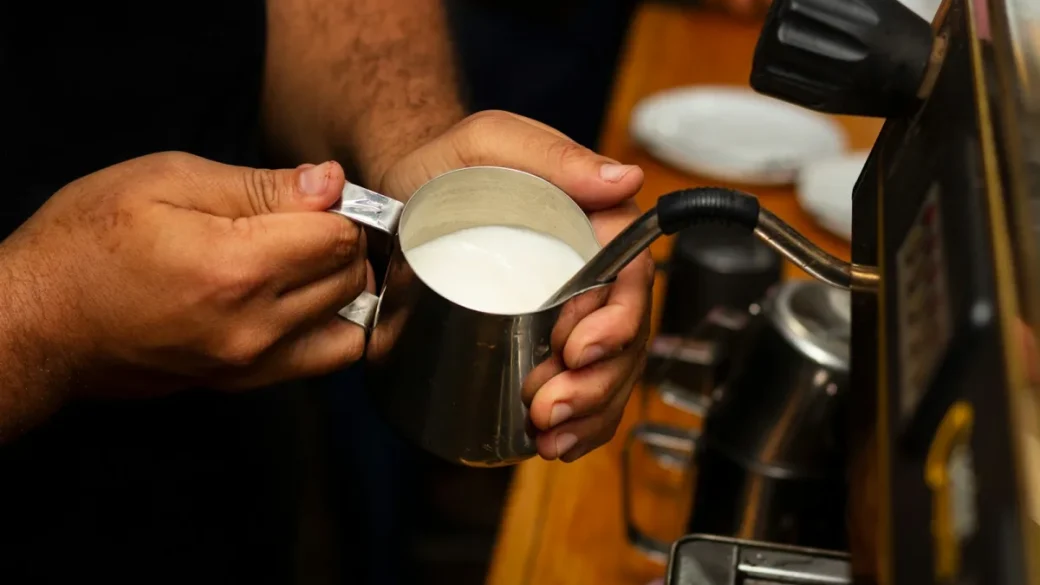
If you pull one shot and walk away, 40 seconds doesn’t matter. If you’re making two lattes back-to-back before work while a toddler screams, that near-instant readiness is the single feature people notice every single day.
ThermoJet also means the Pro transitions from brewing to steaming much faster – around 10 seconds instead of the Express’s longer recovery. For milk drinkers that’s the real time saver, not just the initial heat-up.
Grinder and portafilter: closer than the price suggests
Both machines carry an integrated conical burr grinder and both use a 54mm portafilter – not the café-standard 58mm, which matters if you ever want to swap in third-party baskets. The grinders are near-identical in output. Same burr set, same dose control, same slightly-too-loud whir at 7am.
The Pro gives you more grind settings on paper (30 versus the Express’s range), but in practice the usable window for espresso is narrow on both. You’ll live in a band of maybe five or six settings once you dial in your beans.
If someone tells you the Pro pulls better espresso than the Express, they’ve confused a faster machine with a better one. The shot quality ceiling is the same.
What genuinely helps on both is the built-in grinder and dosing, which is why these are such common picks for a first “real” setup. If you’re still weighing whether an all-in-one is even the right call, the pillar piece on how to choose a home espresso machine lays out the trade-offs against separate grinder-and-machine builds.
The display and interface
The Express has analog pressure and a fairly basic control panel. The Pro adds a small LCD that shows shot timers, grind settings and step-by-step prompts. It’s genuinely nice to see a live shot timer instead of counting Mississippis in your head.
Here’s my repair-tech caveat, though. That display is one more thing to fail.
I’ve replaced a handful of Pro display assemblies where the ribbon cable worked loose or the panel died outright – a $60 to $90 part plus labor. The Express has fewer electronics to go wrong, which is part of why it’s the easier machine to keep alive for a decade.
Steam wand and milk texturing
Both use a single-hole steam wand with manual control, and both produce microfoam good enough for a passable rosetta if your technique holds up. Neither is a commercial steamer – this is a single boiler design, so you brew and steam in sequence, never at once.
The Pro’s steam comes on faster and feels slightly punchier thanks to ThermoJet. The Express takes a beat longer to build steam pressure. If you froth milk every day, that difference compounds.
On either machine, purge the wand for 2-3 seconds before and after steaming. Milk that dries inside the tip is the number one cause of weak steam and the clogged wands I see constantly. Thirty seconds of maintenance saves a service call.
If steaming performance is high on your list and you don’t mind stepping outside the Breville family, the reason true dual-boiler machines exist is worth understanding – I break that down in the piece on single vs dual boiler espresso machines.
Side-by-side: what you actually pay for
| Feature | Barista Express | Barista Pro |
|---|---|---|
| Typical price (USD) | ~$700 | ~$850-900 |
| Heating system | Thermocoil | ThermoJet |
| Cold heat-up | 30-45 sec | ~3 sec |
| Portafilter | 54mm | 54mm |
| Grinder | Conical burr, integrated | Conical burr, integrated |
| Display | Analog gauge | LCD with shot timer |
| Boiler type | Single | Single |
| Serviceability | Simpler, cheaper | More electronics |
Look at that grid and the story is clear. You’re paying the premium for speed and a display, not for better coffee. Breville publishes the full spec sheets on their official site if you want to confirm the numbers before buying.
What breaks, and what it costs to fix
Both machines fail in the same predictable way: scale. Hard water leaves calcium in the heating path, flow drops, and eventually the machine throws a fault or stops pulling shots entirely. This is a single boiler design with narrow water paths, so it’s unforgiving of neglect. The espresso machine as a category has always lived and died by descaling discipline.
Always unplug the machine and let it cool fully before removing any panel. There’s a thermal cut-out and mains voltage inside. Descale every 2-3 months with hard water using Breville’s own solution or a citric acid mix – vinegar can degrade internal seals over time.
A few things I’d flag from the bench:
- The Express’s thermocoil is a straightforward, cheaper part to replace when it finally clogs.
- The Pro’s ThermoJet unit costs more and takes longer to swap.
- Both share the same steam wand and portafilter assemblies, so wear parts are easy to source.
- The Pro’s LCD adds a failure point the Express simply doesn’t have.
None of this makes the Pro a bad machine. It just means the extra complexity has a small long-term cost that spec sheets never mention.
So which one should you buy
Buy the Express if you mostly drink straight espresso or one milk drink a day, want the simpler machine to maintain, and would rather put that $150 toward better beans or a scale. It does everything the Pro does in the cup.
Buy the Pro if you steam milk daily, make drinks for more than one person, and value getting from cold to poured in under a minute. That speed is the upgrade you’ll feel every morning for years.
If you’re new to all of this and still deciding whether a Breville is even where you should start, the rundown of the best first espresso machine for beginners is a good next stop – and if you’re the type who’d rather tinker with a repairable classic, compare notes with my Gaggia Classic vs Rancilio Silvia breakdown before you commit.
Frequently asked questions
No. Both use the same 54mm portafilter and a near-identical conical burr grinder, so the shot-quality ceiling is effectively the same. The Pro heats faster and adds a shot timer, but the actual espresso you pull is determined by your beans, grind and technique, not by which of these two machines you own.
It depends on how you drink. The roughly $150 to $200 premium mostly buys the ThermoJet heating system, faster steam recovery and an LCD display. If you make several milk drinks daily and hate waiting, that speed pays you back every morning; if you drink one straight espresso, the Express is the smarter spend.
The Express is simpler on the bench. It has fewer electronics and its thermocoil is a cheaper part to replace than the Pro's ThermoJet unit. The Pro's LCD display is an extra failure point that can cost $60 to $90 plus labor if it dies. Both fail mainly from scale, so descaling every 2 to 3 months matters more than the model you choose.
No. Both the Express and the Pro use a 54mm portafilter, which is smaller than the 58mm café standard. That limits your choice of third-party baskets, tampers and bottomless portafilters compared with a machine built around 58mm. Stick with 54mm accessories or Breville's own parts.
No. Both are single boiler machines, so they heat water for brewing and steaming in sequence, never simultaneously. The Pro switches between the two modes faster thanks to ThermoJet, but if you want true simultaneous brew-and-steam you need a dual boiler or heat-exchanger machine, which is a different price bracket entirely.
With hard water, every 2 to 3 months; with soft or filtered water you can stretch it longer. Scale buildup in the narrow water paths is the number one cause of the faults I see on both machines. Use Breville's descaling solution or a citric acid mix rather than vinegar, which can degrade internal seals over time.