
Key takeaways
- Descale on a schedule tied to your water hardness and shots per day, not a fixed calendar date - soft water plus low use can stretch to 4 months, hard water plus heavy use needs it monthly.
- Test your water with a cheap GH strip ($8 for 50) before you guess; most people underestimate their hardness by a full tier.
- A machine that takes longer to heat, drips slower, or knocks during warm-up is already scaled - don't wait for the light.
- Filtered or bottled water at 50–100 ppm roughly halves how often you'll need to descale versus straight tap.
Every January my bench fills up with the same casualty: a machine that pulled fine in June and by winter won’t push water past the group. The owner swears they descaled it “recently.” When I ask when, the answer is almost always a shrug and “maybe last year?”
Scale doesn’t care about your intentions. It cares about two things – how hard your water is and how much coffee you make. Get those two numbers and the frequency answers itself.
So let’s turn “how often should I descale my espresso machine” into an actual number you can put on a calendar.
Why frequency is a formula, not a fixed date
Limescale is calcium and magnesium dropping out of your water when it’s heated. The hotter and the more often you heat it, the faster it plates onto your boiler walls and heating element.
A single-boiler Gaggia Classic heating up twice a day sees far less thermal cycling than a dual-boiler machine held at 200°F all morning. Same water, very different scale rate.
That’s why a blanket “every three months” rule is useless. I’ve seen soft-water machines run a clean boiler at 18 months, and I’ve cut open hard-water boilers at four months that looked like a cave.
Your descale interval is set by the water going in and the shots coming out – everything else is noise.
Step one: know your water hardness
Water hardness is measured in parts per million (ppm) of calcium carbonate, or sometimes in German degrees (dGH). One dGH is roughly 17.8 ppm. You don’t need lab gear to find yours.
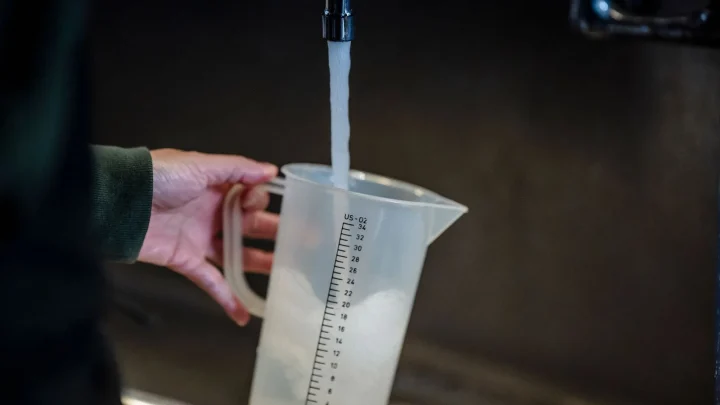
Grab a box of GH test strips – the aquarium kind work perfectly and run about $8 for 50. Dip one in your cold tap for a second, wait 30 seconds, match the color. That’s your baseline.
Here’s how the ranges break down:
| Category | Hardness (ppm) | Roughly (dGH) | What you’ll see |
|---|---|---|---|
| Soft | 0–60 | 0–3 | Slow scaling, easy life |
| Moderate | 61–120 | 3–7 | Typical municipal supply |
| Hard | 121–180 | 7–10 | Visible scale on kettles |
| Very hard | 180+ | 10+ | White crust everywhere |
Most people I test guess one full tier too soft. If your kettle grows a white ring in a week, you are not on “moderate” water – you’re hard, minimum.
The Specialty Coffee Association targets around 50–70 ppm total hardness for brewing. That’s also the sweet spot for scale: enough minerals for flavor, few enough to keep your boiler clean.
Step two: the descale frequency lookup
Now cross your water hardness with your daily habit. “Cups” here means espresso shots or milk drinks – anything that heats and moves water through the boiler.
| Water | 1–2 cups/day | 3–5 cups/day | 6+ cups/day |
|---|---|---|---|
| Soft (0–60 ppm) | Every 4 months | Every 3 months | Every 8–10 weeks |
| Moderate (61–120) | Every 3 months | Every 6–8 weeks | Every 4–6 weeks |
| Hard (121–180) | Every 6–8 weeks | Every month | Every 3 weeks |
| Very hard (180+) | Monthly | Every 3 weeks | Every 2 weeks (or filter, please) |
Find your row, find your column, put it in your phone calendar as a repeating event. That single step prevents most of the machines that land on my bench.
If you land in the “every 2 weeks” corner, that’s your machine begging for a water filter. Descaling that often shortens the life of your seals and does your patience no favors.
Switch to bottled or filtered water at 50–100 ppm and you can move up one full tier on this chart. That’s the cheapest maintenance upgrade there is – a $25 inline filter often pays for itself in a year of skipped descales.
The machine will tell you before the light does
Descale indicator lights are timers or crude conductivity guesses, not scale sensors. On a Breville they count shots; on a De’Longhi they count water volume. Neither knows what your actual boiler looks like.
Your senses are better. Watch for these:
- Heat-up time creeping longer – a machine that hit temp in 25 seconds now taking 45
- Flow rate dropping, so your usual 25-second shot now runs 35 with the same grind
- Popping or knocking sounds during warm-up as steam gets trapped under scale
- Steam wand losing pressure or spitting instead of a steady jet
- Water tasting faintly metallic or flat
Any two of those together mean you’re overdue, regardless of what the calendar or the light says.
Never run a descaling solution through a machine with a fully blocked group or a scale-jammed pressure relief valve. Trapped pressure behind hardened scale can spit near-boiling water. If flow has stopped completely, unplug it and let it cool fully before you touch anything.
Matching frequency to your specific machine
The chart gets you 90% there, but boiler design shifts the numbers a little.
Single-boiler machines (Gaggia Classic, Rancilio Silvia)
These cool between tasks, so they scale slower for the same water. You can usually lean toward the longer end of your chart cell. The Gaggia aluminium boiler is forgiving, but its narrow passages clog dramatically once scale starts – walk through the process in our home descaling steps for the Gaggia Classic.
Thermoblock machines (most Breville, many De’Longhi)
Thermoblocks have thin, winding channels that scale up fast and unforgivingly. I treat these one tier stricter than the chart. Breville’s own routine is quick once you know it – see our Barista Express descale walkthrough, and Breville ships its cleaning tablets that suit that block design.
Dual-boiler and heat-exchange machines
These sit hot for hours, so they scale like nothing else at the same water. Stick to the strict end of your cell and never skip. For the De’Longhi automatics, the process differs by model – our De’Longhi descaling guide covers the button sequences that trip people up.
Whatever you run, use the right solution and rinse thoroughly. The full method sits in our complete cleaning and descaling overview.
Setting a schedule you’ll actually keep
The best interval is the one you don’t have to remember. Test your water once, read your number off the lookup, and set a recurring reminder – then forget it until it pings.
If you drink coffee every day, tie descaling to something you already track. I tell customers to do it the same weekend they change the smoke-alarm batteries or the furnace filter. The habit sticks because it rides on an existing one.
And keep a small logbook – even a note on your phone. “Descaled March 3, moderate water, three shots a day.” Six months from now that one line tells you exactly whether you’re on track or drifting toward a bench visit.
An espresso machine that’s descaled on time can easily run 8–10 years. The ones I retire early almost always died of neglected scale, not worn parts. A $10 bottle of descaler on a schedule is the cheapest insurance you’ll ever buy for a $600 machine.
Frequently asked questions
Filtered water at 50–100 ppm lets you move up one full tier on the frequency chart. For most home users pulling 3–5 shots a day, that means roughly every 3 months instead of every 6–8 weeks. Still test your filter output occasionally, since spent cartridges quietly let hardness climb back up.
Yes. Descaling more than every couple of weeks starts to wear rubber seals and O-rings from repeated acid exposure. If your chart position says every two weeks, that's a signal to install a water filter rather than keep hammering the boiler with descaler.
Not reliably. Breville counts shots and De'Longhi counts water volume, so both are estimates based on averages, not real scale sensors. Treat the light as a reminder to check, but trust changes in heat-up time and flow rate more than the indicator itself.
Scale narrows the boiler passages until flow slows, heat-up drags, and eventually the group blocks entirely or the pressure relief valve jams. At that point you're looking at a boiler flush or replacement, often $80–150 in parts and labor, versus a $10 bottle of descaler used on time.
I don't recommend it. Vinegar is weak against heavy scale, leaves a smell that takes many rinse cycles to clear, and can attack aluminium boilers like the one in a Gaggia Classic. A citric-acid or dedicated espresso descaler costs a few dollars more and rinses cleaner.
Use a GH test strip - the aquarium type works fine and costs about $8 for 50. Dip it in your cold tap, wait 30 seconds, and match the color to the chart on the box. Many local water utilities also publish an annual hardness figure on their website if you'd rather look it up.