
Key takeaways
- The group head is where water meets coffee at around 200°F and 9 bars, and its rubber gasket is the single most common part I replace.
- Your portafilter and basket set the dose and channel the flow, so treat them as a matched pair, not spares.
- Descaling the boiler every 4 to 8 weeks prevents the slow, expensive death that kills most cheap machines.
- The steam wand and its tip do all the milk work, and a clogged 3-hole tip is usually just dried milk, not a fault.
- Learn the drip tray, water tank and float, and you'll head off half the leaks that get blamed on the pump.
The first time I opened up a customer’s Gaggia Classic on my bench, she stood over my shoulder and pointed at the shiny metal disc up top and asked, “What’s that bit called?” She’d owned the machine for three years. She’d made maybe two thousand shots through it. And she had no name for the one part every single drop of her coffee passed through.
That’s normal. Most people learn to press the button before they learn the anatomy.
So here’s the tour I wish someone had given her on day one: every part you can see and touch on a home machine, what it’s called, and what it actually does. If you want the wider picture of how espresso all works before we start naming parts, that’s the place to begin.
1. The Group Head: Where Water Meets Coffee
That shiny metal disc my customer pointed at is the group head (or “brew group”). It’s the business end of the machine. Hot water arrives here, gets forced through your packed coffee, and leaves as espresso.
Look up into it and you’ll see a mesh disc called the shower screen (or dispersion screen). Its job is to spread the water evenly across the whole coffee bed instead of drilling one hole through the middle.
The group gasket – my most-replaced part
Just inside the rim sits a rubber ring, the group gasket (or brew seal). When your portafilter stops locking tight, or coffee sprays out of the sides mid-shot, this hardened little ring is the culprit nine times out of ten.
A gasket costs about $5 to $9. I’ve replaced hundreds. They typically go brittle at 12 to 18 months of daily use.
If your portafilter handle creeps further and further right when you lock it in over the months, the gasket is compressing and aging. When it passes the 6 o’clock position, order a replacement before it starts leaking.
2. The Portafilter and Basket: Your Coffee’s Home
The portafilter is the handled metal cup you fill with grounds and twist into the group head. Beginners call it “the handle,” which is fine, but knowing the real name helps when you’re buying accessories.
Inside it sits a removable perforated cup, the basket (or filter basket). This is where your dose lives. A standard double basket holds around 18 grams of coffee.
Baskets and portafilters are a matched pair, sized to each other. Swapping a random basket into the wrong spout can cause leaks and bad flow. There’s more nuance to this in our breakdown of what a portafilter is and how to use it.
Cheaper machines often ship with a pressurised basket (double-walled, single tiny exit hole). It fakes pressure so any grind works. A non-pressurised basket gives real control but demands a proper grind and dose. If your crema looks like foamy bubbles that vanish fast, a pressurised basket is usually why.
3. The Boiler and Thermoblock: The Heat Source
Hidden inside the body is whatever heats your water. On older and mid-range machines that’s a boiler, a metal tank that holds and heats water to brewing temperature.
Espresso wants water around 195°F to 205°F. Go hotter and you scorch the coffee into ash and bitterness. Go cooler and it comes out sour and thin.
Many compact machines instead use a thermoblock (or thermocoil), which heats water on demand as it flows through a metal maze. Faster to warm up, but it can struggle to hold a steady temperature during long steaming.
Never open a boiler or poke inside the body while the machine is plugged in. These run on mains voltage and hold scalding water under pressure. Unplug it, let it cool for at least 30 minutes, and if you’re not confident, leave the internals to a technician.
Limescale, the silent killer
Boilers die from scale. Hard water leaves chalky mineral deposits that choke the heating element and narrow the pipes. I’ve cut open failed boilers packed with crust an eighth of an inch thick.
Descale every 4 to 8 weeks depending on your water. A bottle of descaler runs about $10 and outlives the machine you save.
4. The Pump and the 9-Bar Rule
Real espresso needs pressure, and the pump supplies it. Most home machines use a small vibration pump (or vibratory pump), the part that makes that loud buzzing rattle when you pull a shot. It’s not broken. It’s just how they sound.
The target is roughly 9 bars of pressure at the coffee, which is about 130 psi. That number isn’t arbitrary; it’s the pressure that pushes water through finely packed grounds at the right speed. We go deeper on what 9 bars of pressure actually means if you’re curious why that figure matters.
A vibration pump that buzzes is working. A pump that’s gone silent, or screams at a new pitch, is the one to worry about.
Some machines have an OPV (over-pressure valve) that bleeds off anything above the target, so you don’t crush the coffee at 15 bars. The “15 bar” number splashed on the box is the pump’s maximum, not what reaches your cup. According to the general history of the espresso machine, pump-driven pressure only became standard in home units decades after the first café machines.
5. The Steam Wand: Milk’s Best Friend
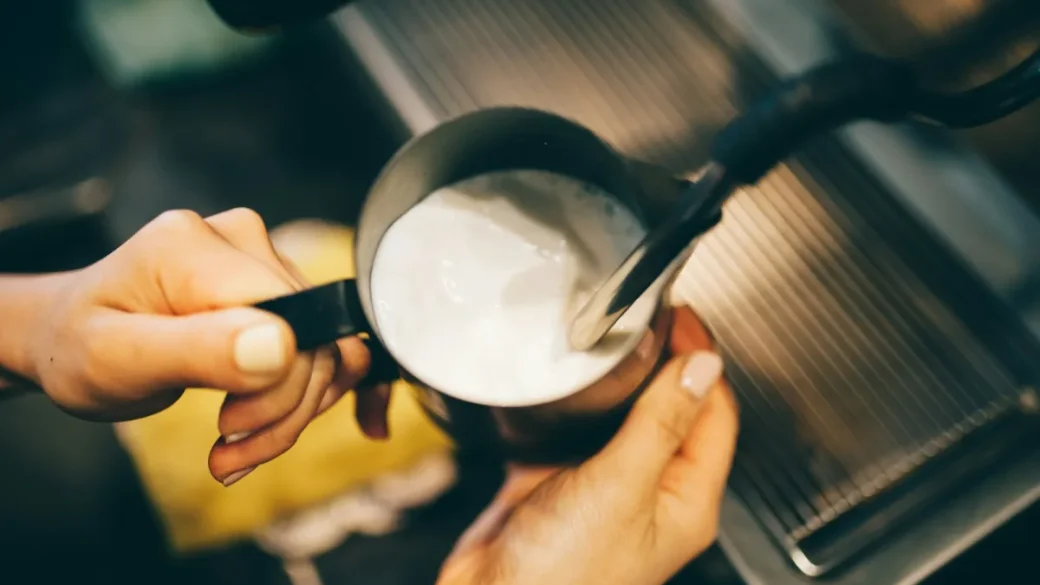
That thin metal arm sticking out the side is the steam wand. Open its valve and it blasts pressurised steam to heat and froth milk for lattes and cappuccinos.
At the end is the steam tip, a small screw-on nozzle with tiny holes. A single-hole tip on a budget machine froths slowly; a 3 or 4-hole tip on a stronger machine can texture a jug in 20 seconds.
The most common “my steamer stopped working” call I get is simply dried milk clogging those pinholes. It’s not a fault, it’s housekeeping.
- Purge the wand for 2 seconds before and after every use
- Wipe it with a damp cloth immediately, while it’s still hot
- Unscrew and soak the tip in warm water weekly
- Poke clogged holes with a clean pin, never a paperclip that leaves metal shavings
All that steam and pressure is what builds the golden foam on top of your shot. If you’ve ever wondered why crema forms on espresso, it comes from the same forces at play in the group.
6. The Everyday Bits: Tray, Tank and Knobs
These parts feel too obvious to name, but they cause a shocking share of the leaks I get blamed on “the pump.”
Water tank and float
The removable water tank (or reservoir) usually clips onto the back or side. Many have a small float or sensor that tells the machine when you’re running dry. A stuck float is why a full tank sometimes reads empty.
Drip tray
The drip tray catches spills, purges and the drops from your portafilter. Its grille lifts out; the tray underneath needs emptying before it overflows onto your counter. Most hold 300 to 500 ml.
Controls
Up front you’ll find the brew switch or paddle, a steam dial, and often a hot water spout for tea or Americanos. Some machines add a pressure gauge, a little dial showing bars during the shot; watch it climb to 9 and hold there for a healthy pull.
| Part | What it does | Typical replacement cost |
|---|---|---|
| Group gasket | Seals the portafilter to the group | $5 – $9 |
| Shower screen | Spreads water over the coffee | $8 – $15 |
| Steam tip | Textures the milk | $6 – $20 |
| Filter basket | Holds the coffee dose | $10 – $25 |
| Vibration pump | Generates brew pressure | $30 – $60 |
Knowing the Names Makes You Faster
Here’s what changes once you can name these parts: you stop feeling helpless when something goes wrong.
A shot spraying sideways stops being “the machine is broken” and becomes “the group gasket is done.” Weak, bubbly crema stops being a mystery and becomes “I’m on a pressurised basket.” Milk that won’t froth becomes “the steam tip needs a soak.”
Brands like Breville and Gaggia build these parts to be user-serviceable for a reason. Spend ten minutes learning the names on your own machine tonight, pull the drip tray, unscrew the steam tip, look up into the group. Every one of those parts is something you can now understand, clean, and eventually replace yourself.
That’s the difference between owning an espresso machine and just pressing its button.
Frequently asked questions
That's the group head, sometimes called the brew group. It's where hot water is forced through your coffee. Look up inside it and you'll see the shower screen (which spreads the water evenly) and a rubber group gasket around the rim that seals the portafilter in place.
Almost always a worn group gasket. That rubber ring hardens over 12 to 18 months of daily use and stops sealing, so pressurised water escapes around the edges. A new gasket costs about $5 to $9 and is one of the easiest parts to swap yourself once the machine is cool and unplugged.
A boiler is a metal tank that heats and holds a volume of water at brewing temperature, giving steadier heat for steaming. A thermoblock heats water on demand as it flows through, so it warms up faster but can struggle to hold temperature during long steam sessions. Compact and budget machines usually use thermoblocks.
Both, sort of. The 15 bar figure is the pump's maximum capability printed on the box for marketing. What actually reaches your coffee is closer to 9 bars, often regulated down by an over-pressure valve. Nine bars at the coffee bed is the sweet spot for good extraction.
Nine times out of ten it's dried milk clogging the tiny holes in the steam tip, not a real fault. Unscrew the tip, soak it in warm water, and gently clear the holes with a clean pin. Purging the wand for two seconds before and after each use, then wiping it while hot, prevents the clog coming back.
Yes, especially with hard water. Limescale builds up inside the boiler and pipes, choking the heating element and eventually killing the machine. Descaling every 4 to 8 weeks with a $10 bottle of descaler is the single cheapest way to make a home machine last for years.