Key takeaways
- The Barista Express (BES870) has a hidden descale mode - hold POWER, then press the '2 CUP' and 'HOT WATER/STEAM' buttons together while powering on.
- Run the full cycle roughly every 2-3 months on hard water; the machine tracks shot count and flashes the descale light on its own timer.
- Budget about 15-20 minutes and 2 liters of water - the cycle drains through the group, hot water spout, and steam wand in three separate stages.
- Use Breville's own descale tablets (about $10 for a 4-pack) or a citric-based solution; never use straight vinegar in this machine.
- The single most common no-flow fault I see is scale in the solenoid and cold-water valve, not a dead pump.
The first Barista Express that landed on my bench with a “dead pump” was anything but. The owner had run it for three years on Phoenix tap water and never once touched the descale routine. When I pulled the top cover, the cold-water inlet valve was crusted shut with a chalky ring you could scrape with a fingernail.
That machine – a BES870XL – didn’t need a $90 pump. It needed twenty minutes and a $2.50 descale tablet.
The Barista Express hides its descale mode behind a button combination most owners never find, and the manual buries it on page 26. So let me walk you through the exact sequence I use, the way I’d show a customer standing next to me at the counter.
Why This Machine Scales Up Faster Than People Expect
The Barista Express uses a single thermocoil rather than a boiler. Water flows through a narrow aluminum passage that heats fast – great for pulling a shot 30 seconds after switch-on, terrible for scale, because dissolved calcium and magnesium precipitate hardest exactly where water gets hottest.
On hard water above roughly 200 ppm, I see meaningful buildup inside 12 weeks. Soft water buys you closer to five or six months.
Scale doesn’t just slow flow. It insulates the thermocoil, so your brew temperature drops a few degrees and your shots start tasting sour and thin even though nothing looks wrong. If you want the wider picture on how mineral buildup wrecks any machine, our overview on how to clean and descale an espresso machine covers the chemistry in plainer terms.
The Barista Express counts your shots and lights the “descale” indicator on a rolling timer – but that timer assumes average-hardness water. If your kettle furs up quickly, descale on your own schedule and don’t wait for the light.
What You’ll Need Before You Start
Get everything to hand first. Once the cycle starts you don’t want to be hunting for a jug while hot solution sits in the group head.
- Breville descale tablets (about $10 for a pack of 4) or a citric-acid descaler – one tablet or one sachet per cycle
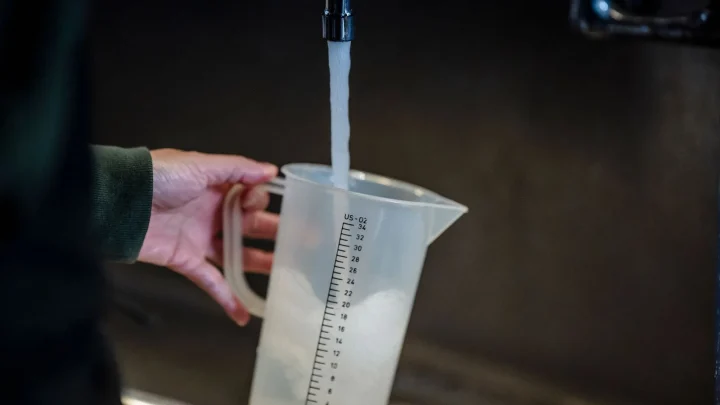
- 2 liters of fresh water for the descale and rinse stages
- A container that holds at least 34 oz / 1 liter to catch the outflow
- The gray silicone cleaning disc that shipped in the box (or a blind/blank filter basket)
- The single-wall filter basket seated in the portafilter
- A microfiber cloth for the steam wand and drip tray
Never run neat white vinegar through a Barista Express. The acetic acid attacks the internal silicone seals and the aluminum thermocoil over time, and you’ll be chasing a slow drip six months later. Breville’s own descale product or a proper citric-based descaler is the only thing I put through these.
Mixing the Solution and Loading the Tank
Empty the water tank completely and remove the water filter holder from inside it – that little charcoal filter will absorb your descaler and skew the whole cycle. Set it aside.
Fill the tank to the DESCALE line marked on the side (roughly 34 oz / 1 liter) with lukewarm water, then drop in one tablet. Give it two or three minutes to fully dissolve; a half-dissolved tablet can rattle around and block the inlet.
Seat the tank firmly back on the machine. If it’s not clicked down properly the pump will run dry and cavitate, which sounds alarming but usually just means the tank isn’t home.
If the tablet hasn’t fully dissolved, the cycle hasn’t really started. Cloudy water in, clean flow out – that’s the whole job.
Entering Descale Mode: The Button Combination
This is the part nobody stumbles on by accident. With the machine switched off at the wall but the power button reachable, here’s the sequence for the BES870 and its siblings.
The exact sequence
- Make sure the machine is powered down (front POWER button off).
- Press and hold the POWER button, and while holding it, press the 2 CUP and HOT WATER / STEAM buttons at the same time.
- The buttons will illuminate and the machine drops into descale mode – you’ll see the LEDs behave differently than a normal warm-up.
On the newer Barista Express Impress the layout differs slightly and the machine walks you through on its display, but the BES870 relies purely on this button combo. If nothing lights up, you’ve likely let go of POWER too early – hold it down through the whole press.
Seat the portafilter with the cleaning disc or a blind basket before you enter descale mode, and lock it into the group head. The cycle pushes solution through the group, and without the disc it sprays straight down into the tray and splashes.
Running the Three-Stage Cycle
The Barista Express descale runs in three distinct passes, and each one needs your hand on a different button. Position your 34 oz container under the group head, the hot water spout, and the steam wand as each stage calls for it.
Stage 1 – the group head
Press the 1 CUP or 2 CUP button to start solution flowing through the brew group. It runs for a set volume then stops on its own. Expect this to take 60 to 90 seconds.
Stage 2 – the hot water spout
Rotate the dial to HOT WATER. Solution now purges through the water spout, clearing scale from that separate path. Give it the full run – don’t cut it short.
Stage 3 – the steam wand
Switch the dial to STEAM and let solution work through the wand. This is the stage people skip, and it’s why so many wands end up with weak, spitting steam. The wand has its own tiny orifice that scales up fast.
When all three stages are done, the machine signals completion. That whole descale pass usually takes me 8 to 10 minutes start to finish.
| Stage | Control used | What it clears | Rough time |
|---|---|---|---|
| 1 | 1 CUP / 2 CUP | Group head and solenoid path | 60-90 sec |
| 2 | Hot water dial | Hot water valve and spout | 45-60 sec |
| 3 | Steam dial | Steam wand and orifice | 45-60 sec |
The Rinse – Don’t Skip It
Descaler left in the lines will taint your next few shots with a sharp, metallic bite. So the rinse matters as much as the descale itself.
Pull and empty the drip tray, then rinse the tank thoroughly and refill it with plain fresh water to the MAX line. Run the entire three-stage cycle again – group, hot water, steam – with clean water. I usually run it twice with fresh water on machines that were badly scaled.
Reinstall the charcoal water filter in the tank once you’re done rinsing, not before. Then pull a throwaway shot and dump it. If it tastes clean, you’re back in business.
The mineral content that scales your machine is the same stuff that shapes the flavor of the shot itself – the Specialty Coffee Association publishes water standards that most home setups never hit. A cheap inline softener or filtered water halves how often you’ll be doing this.
Keeping It From Coming Back
Descaling is the cure. Water management is the prevention, and it’s where I’d rather you spend your energy.
Keep the Breville charcoal filter fresh – swap it every 2 to 3 months, sooner on hard water. Better yet, fill the tank with filtered or bottled water around 50-100 ppm and the descale light might not appear for half a year.
The routine on a Barista Express is genuinely simpler than on a lot of machines. If you’ve wrestled with the button-menu approach on a De’Longhi or done the manual solution-soak on a Gaggia Classic, Breville’s dedicated mode does most of the thinking for you.
And while descaling handles the water side, it doesn’t touch coffee-oil buildup behind the shower screen. Pair your quarterly descale with a proper backflush routine and your Barista Express will pull the same shot in year five that it did on day one – no phantom pump replacement required.
Frequently asked questions
On hard water above roughly 200 ppm, every 8 to 12 weeks. On soft or filtered water you can stretch it to five or six months. The machine's descale light is a rough guide based on shot count, but if your kettle furs up quickly, descale on your own schedule rather than waiting for it.
On the BES870, hold the POWER button and, while holding it, press the 2 CUP and HOT WATER/STEAM buttons together. The buttons will illuminate and the machine drops into descale mode. If nothing happens, you probably released POWER too early - keep it held through the whole press.
I strongly advise against it. Neat white vinegar attacks the silicone seals and aluminum thermocoil inside the Barista Express and can cause slow leaks months later. Use Breville's own tablets (about $10 for four) or a proper citric-acid descaler instead.
The descale pass itself runs about 8 to 10 minutes across the three stages - group head, hot water, and steam. Add a rinse cycle or two with fresh water and you're looking at 15 to 20 minutes total. Don't rush the rinse or your next few shots will taste metallic.
That sharp, metallic edge usually means descaler residue is still in the lines. Run at least one full three-stage cycle with plain fresh water, then pull and dump a throwaway shot. On a badly scaled machine I rinse twice to be sure it's fully cleared.
Yes. The charcoal filter inside the tank will absorb the descaler and throw off the cycle, and the acid shortens its life. Take it out before you mix the solution, and reinstall a fresh one only after the final rinse is complete.